When to Consider Contract Manufacturing: 5 Signs Your Operation Is at Its Limit
As businesses grow, production models that once worked well can start to show strain. What began as an efficient, hands-on operation can become increasingly complex, costly, and difficult to scale.
Whether you’re managing in-house manufacturing, liquid or powder blending, filling bottles, or pouching finished goods, the same challenges tend to emerge as demand increases.
For many companies with escalating demand, the challenge is not whether they can continue managing production internally. It’s whether they should.
Contract manufacturing is often viewed as a last resort. In reality, the earlier this ‘last resort’ is considered, the more likely a brand is to successfully scale with its demand. It’s critical to prepare for scale before operational issues start impacting growth, cost, or customer experience.
Here are five common signs that your current manufacturing setup may be reaching its limit.
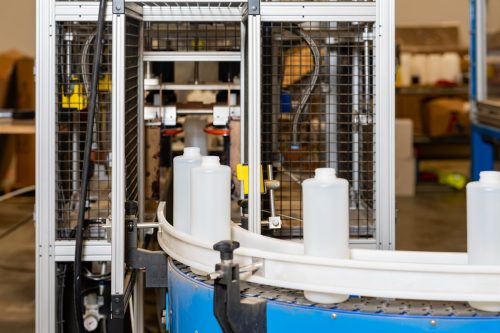
1. Production Capacity Is Constantly Tight
If your team is consistently operating at or near full capacity, even small disruptions can create delays.
Backlogged orders, extended lead times, inability to take on new business... this issue can rear its head in many forms.
At this stage, your brand’s growth becomes constrained not by demand, but by your ability to produce at the required pace.
Adding internal capacity can be expensive and time-consuming, not to mention risky. Turning to a contract manufacturing partner provides a way to expand production without major capital investment or operational disruption.
2. Forecasting Feels Unpredictable
Many growing companies struggle with demand variability. Orders can spike unexpectedly, especially in e-commerce or consumer-driven markets. Growing companies may not yet have systems in place for effective forecasting as demand begins to accelerate.
When forecasting is inconsistent (or borderline nonexistent), it creates challenges such as:
- > Overstocking raw materials
- > Running short on finished goods
- > Difficulty aligning production with demand
A chemical contract manufacturing partner can help absorb these fluctuations, providing flexibility in both production and supply chain planning.
3. Internal Resources Are Stretched Thin
As production scales, it doesn’t just hit one area. You start to feel it across procurement, production, packaging, fulfillment, and quality.
When internal teams are constantly reacting, efficiency falls off and errors become more common.
A company in this position can benefit from offloading the most resource-intensive parts of its operation, allowing internal teams to focus on higher-value work. Companies with strong branding and sales capabilities can stay focused on what drives growth, while shifting production, sourcing, and supply chain execution to a custom chemical manufacturing partner.
4. Product Changes Are Slowed by Operational Constraints
For many companies, product evolution is ongoing. Whether it’s reformulation, packaging updates, or new product development, change is constant in order to stay competitive.
Limited internal production operations can create some unintended barriers that stunt a company’s growth:
- > Large raw material commitments
- > Rigid production schedules
- > Limited testing or validation capabilities
These constraints slow down innovation. A chemical manufacturing partner with lab and formulation support (and strong sourcing capabilities) can help companies adapt faster, making product changes without being locked into existing inventory or timelines.
5. Costs Are Increasing Without Clear Improvement
One of the most overlooked signals is rising cost without corresponding gains in efficiency. This can often be written off as business as usual, but it usually runs deeper than that.
Increasing costs or shrinking margins can be driven by:
- > Fragmented suppliers
- > Inefficient processes
- > Excess labor requirements
- > Poor coordination between sourcing, production, and packaging
- > Limited purchasing power due to lower volumes and less optimized sourcing
Looking at individual costs may not reveal the issue. The real problem is often the total cost of the program.
A structured, well-positioned contract manufacturing partner can help streamline operations, reduce complexity, and improve overall cost efficiency. In many cases, companies operating at smaller volumes simply don’t have the purchasing power or production efficiency of a larger, integrated manufacturing partner.
Rethinking Contract Manufacturing
Contract manufacturing isn’t just about outsourcing production. It’s about improving your entire manufacturing operation.
The most effective partnerships:
- > Integrate production, sourcing, and packaging
- > Provide flexibility to scale with demand
- > Support product development and ongoing changes
- > Operate as an extension of your team
For some companies, this means replacing an existing supplier. For others, it means extending beyond in-house operations to a hybrid manufacturing model that supports sustainable growth.
If your current production model is creating constraints instead of supporting growth, it may be time to evaluate your options.
The right contract manufacturing partner can help you scale production, reduce operational strain, and improve efficiency, without sacrificing quality or control.
Do you see these challenges in your own operation? It’s worth having the conversation early. Explore Haviland’s contract manufacturing capabilities!
Get In Touch
Contract manufacturing isn’t just about outsourcing production. It’s about improving your entire manufacturing operation.